
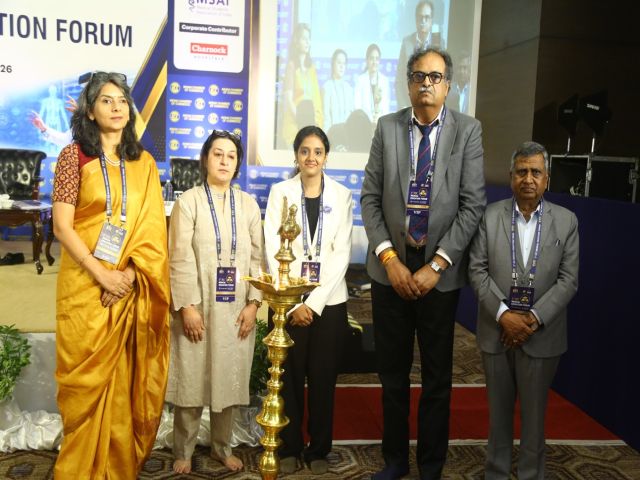
50,000 Doctors Trained in AI, 20 Lakh in CPR: Dr Abhijat Seth Reveals NBEMS Scale at 2nd ICC Medical Education Forum
The 2nd ICC Medical Education Forum, organised by the Indian Chamber of Commerce (ICC) in association with the Medical Students Association of India (MSAI), brought together India's medical education regulators, nursing leadership, academic faculty and student representatives to discuss reforms in clinical training, simulation, competency-based curricula and artificial intelligence in healthcare education.
Addressing the gathering as Guest of Honour, Dr Abhijat Chandrakant Seth, Chairperson of the National Medical Commission, said India now has more than 820 medical colleges and that the country's responsibility now is to raise standards, not simply add numbers.
“The ultimate measure of our success will not be how many doctors we are going to create, but what kind of doctors we are going to create, who will be serving the society,” Dr Seth said. “We cannot create a two-tier medical education system, where students in some institutions have access to excellent faculty, rich medical material, simulation facilities and research opportunities, while other students receive significantly fewer opportunities.”
On artificial intelligence, he said, “Modern education must prepare students not merely to use AI, but to understand it as well. AI should never replace professional responsibility and accountability. The doctor must remain accountable for decisions made in the care of patients. That is where technology ends and humanity begins.” He cited NBEMS data showing close to 50,000 doctors have completed structured online AI training in 2026, and that the board's CPR programme reached approximately 20 lakh healthcare professionals in 2023.
Dr T. Dileep Kumar, President of the Indian Nursing Council (INC), spoke about the Council's work building simulation-based nursing education, drawing a comparison with pilot training.
“The passenger's safety is in the hands of the pilot. The pilot is generally trained through simulators, and we, the doctors and nurses, are responsible for patient safety,” Dr Kumar said. He cited a National Council of State Boards of Nursing study showing up to 50 percent of a BSc Nursing curriculum can be taught through simulation, and described how the INC, with Jhpiego, Laerdal Medical India and SGT University, Gurugram, built India's first National Reference Simulation Centre, followed by a second at the Sajjalashree Institute of Nursing Sciences, Bagalkot.
“Hardware is very easy to get. By spending the money, you can get the hardware. But software is very important. What is software? Software is the teachers, the faculty, and they need to be trained to integrate simulation as a method of teaching. It is a big challenge,” Dr Kumar said.
He said the INC has trained close to 2,000 nursing faculty in structured simulation programmes, signed an MOU with the Digital Health Academy for a six-month AI nursing course, and expanded the Nurse Practitioner Critical Care programme to around 66 institutions. He added that India has been elected for the first time to the board of the International Council of Nurses, and has submitted a shortlisted bid to host the ICN Congress in 2029.
Dr Richa S Debgupta, Co-Chair of the ICC National Healthcare Committee and Executive Vice President at Fortis Hospitals, said the forum's theme, “Excellence in Medical Education, beams with Quality,” reflected the moment healthcare is in. “While medicine evolves, one thing must remain constant, the quality of the healthcare professional we prepare. Medical education must therefore go beyond knowledge. It must build competence, judgment, compassion, curiosity, and character,” Dr Debgupta said.
Dr Chaitra B.A., President, Medical Students Association of India brought the student perspective to the forum, opening with an account of exhaustion during internship postings. “A larger workforce doesn't necessarily mean a stronger workforce. We have to ask where these professionals are going, what conditions they are working in, whether they are adequately trained, whether they can afford to stay in the system,” Dr Chaitra said, citing MSAI's policy paper on human resources for health.
On AI, she said, “The question is not whether AI belongs in medicine, it already does. The question is whether our medical education is preparing students to use it responsibly.” She called for students to have a more direct role in curriculum design and assessment, adding, “Exhaustion is not a competency, and burnout should definitely not be a workforce strategy.”
Dr Ritika Sud, Professor of Medicine, Lady Hardinge Medical College walked participants through the shift to Competency Based Medical Education (CBME), introduced nationally in 2019. “It was a very subject-oriented, teacher-oriented curriculum where there was more emphasis on rote learning, memorising facts over application. There was no structured early clinical exposure,” Dr Sud said of the earlier system.
She said CBME introduced more than 2,600 defined competencies across the MBBS curriculum, the Demonstrate-Observe-Assist-Perform (DOAP) method, and the Attitude, Ethics and Communication (AETCOM) module, taught through role play and standardised patient encounters and assessed on an ongoing basis. She added India now has approximately 706 medical institutes offering around one lakh MBBS seats a year, and named faculty readiness and examination culture as continuing implementation challenges.
The forum made one thing clear: the numbers in Indian medical education, colleges, seats, simulation centres, are no longer the hard part. Faculty, curriculum design and preparing students for an AI-integrated system are. That was the one point nobody on the dais disagreed on.